


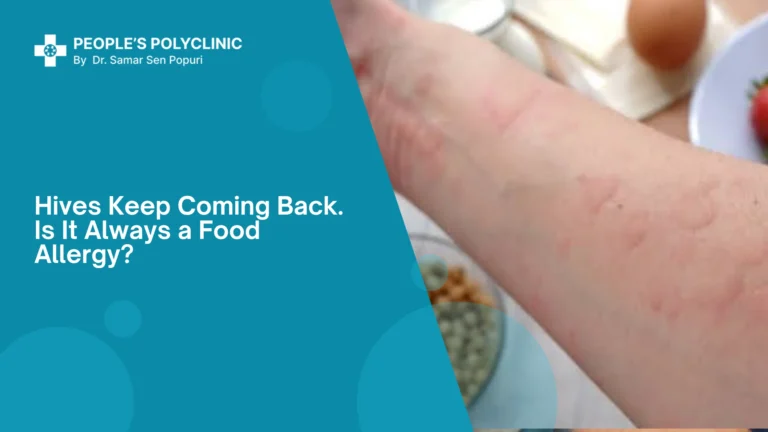
The itchy patches appeared after dinner.
By the next morning, they had disappeared.
You blamed something you ate and decided to avoid it.
Then the rash returned two days later—even though you had not eaten that food.
Now you are checking every ingredient, changing soaps and wondering what else to remove from your routine.
A rash that appears, disappears and returns can be confusing. It can also be difficult to show your doctor if your skin looks clear by the appointment.
Hives are one possible explanation.
However, recurring hives are not always caused by a food allergy. Understanding their pattern can help you avoid unnecessary restrictions and seek more useful medical advice.
What Are Hives?
Hives, also called urticaria, are raised bumps or patches that can appear suddenly and itch intensely. Some people describe burning or stinging instead.
Their appearance varies. On brown or darker skin, the patches may be closer to the surrounding skin colour rather than obviously red.
An individual hive commonly disappears within twenty-four hours, while new ones can appear elsewhere. This can make the rash seem to move around.
These features are clues, not a way to confirm the diagnosis yourself.
Not every itchy rash is hives.
Why Does the Rash Disappear and Return?
The disappearance of one patch does not necessarily mean the entire episode has ended.
You might see a patch on your arm in the evening, clear skin there the next morning and new patches on your back later that day.
Hives can follow this pattern. They are not contagious, although an infection can sometimes be associated with their development.
This distinction matters for families.
You do not need to assume that someone can “catch” your hives. But a clinician should first establish what the rash actually is, particularly when the appearance or accompanying symptoms are unusual.
Is Food Always Responsible?
No.
Food can trigger hives in someone with an allergy. But other possible contributors include medicines, insect bites or stings, infections and physical factors such as heat, cold, sweating or pressure on the skin.
Sometimes, a clear trigger cannot be identified.
Imagine that a rash appears after a meal.
You ate several foods, took medicine, had recently been unwell and spent time in the heat. The meal is memorable, but it is not the only event worth considering.
That does not mean food is irrelevant.
It means the full sequence matters.
A Suspected Trigger Is Not Yet a Confirmed Cause
It is reasonable to notice that a rash followed a particular food or exposure.
Write it down.
But avoid immediately turning that observation into a permanent diagnosis.
A useful history describes:
- What happened before the rash.
- The time between the event and symptoms.
- Whether the same sequence has happened again.
- Whether other symptoms occurred.
- Whether the rash also appeared without that exposure.
If a reaction was severe or strongly suggested an allergy, do not deliberately repeat the exposure to test your theory. Discuss it with a doctor.
You do not need to solve the cause before booking the consultation.
What Does “Chronic Urticaria” Mean?
Hives recurring over six weeks or longer are generally described as chronic urticaria.
When they occur without an identifiable external trigger, doctors may use the term chronic spontaneous urticaria.
“Spontaneous” does not mean imaginary, harmless to your quality of life or caused by something you failed to notice.
It describes a recognised condition for which the cause may remain unclear. Treatment can still be helpful even when a specific trigger is not found.
You do not have to endure six weeks of symptoms before asking for advice. Earlier assessment is appropriate when symptoms keep returning or are troublesome.
Why Repeated Food Restrictions Can Become Unhelpful
People understandably want something practical to change.
One food disappears from the plate. Then another.
Soon, eating feels stressful, but the rash still returns.
Before creating a growing list of prohibited foods, ask whether the pattern genuinely supports those restrictions.
Bring your observations to the consultation and explain what you have already stopped eating. The doctor can help decide whether further allergy assessment or dietary guidance is appropriate.
Do not ignore a confirmed allergy or an existing medical avoidance plan.
The distinction is between following individual advice and restricting more foods based only on uncertainty.
Why Photographs Are Useful
A rash can disappear before the appointment. That does not make your experience less real.
When a flare-up occurs, take clear photographs in good light, if possible.
Include:
- A close view of the patch.
- A wider view showing its location.
- The date and approximate time.
- A note about how long that particular patch remained.
Avoid filters or colour adjustments.
Tell the doctor if the patch is mainly itchy, painful or burning. Also mention whether the same spot remains for more than a day, bruises, develops blisters or behaves differently from previous episodes.
These observations help describe the rash rather than assuming it fits a diagnosis.
Keep a Short, Practical Diary
The diary should support your consultation—not take over your day.
For each episode, note:
- When it began.
- Where the rash appeared.
- How long individual patches lasted.
- Recent medicines and supplements.
- Relevant foods and drinks.
- Heat, sweating, tight clothing or other exposures.
- Recent illness.
- Any swelling or other symptoms.
The American Academy of Dermatology recommends recording these kinds of details when hives are frequent.
There is no need to document every minute or repeatedly inspect your skin. A manageable record is more likely to remain useful.
Do You Need an Allergy Test?
Not automatically.
An assessment starts with the rash, its timeline, your medical history and associated symptoms.
Your doctor may recommend investigations when they could answer a relevant question. The appropriate approach differs between a suspected immediate allergic reaction, recurrent unexplained hives and a rash that may be another condition.
A large test package is not a substitute for that distinction.
Ask:
“What are we trying to establish with this test?”
“How might the result change the next step?”
If symptoms are persistent, widespread or difficult to control, referral to a dermatologist or allergy specialist may be appropriate.
Safe Ways to Reduce Irritation
While arranging advice, keep skin care simple.
Loose clothing and gentle, fragrance-free products may reduce irritation. Avoid very hot showers and vigorous rubbing. A cool compress may be soothing, but avoid cold applications if cold has previously triggered your symptoms.
These measures are for comfort; they do not identify or remove every cause.
Ask a doctor or pharmacist about suitable symptom relief rather than combining several medicines.
Mention existing conditions, pregnancy where applicable and other medicines. Do not use someone else’s treatment or independently increase the dose of a prescribed product.
What If a Medicine Seems Connected?
Record its name and when you took it.
Include prescribed medicines, non-prescription pain medicines, supplements and herbal products.
Contact a clinician promptly for advice if a reaction appears linked to a medicine. Do not take an extra dose to test whether it happens again, or independently alter important regular treatment.
Severe symptoms require emergency care rather than waiting to discuss the prescription at a routine visit.
An old medicine list or photographs of the packaging can help when you cannot recall the names.
When Should You Consult a Doctor?
Seek medical advice when the rash repeatedly returns, spreads, fails to improve or disrupts sleep and daily life.
Arrange prompt assessment if it occurs with fever, feeling unwell or swelling beneath the skin.
Do not assume that recurring symptoms are “just an allergy” without confirming the type of rash.
At the consultation, explain the impact too. “I wake up scratching every night” is important information, not merely a complaint about inconvenience.
Know the Emergency Warning Signs
Sudden swelling of the lips, mouth, tongue or throat, difficulty breathing or swallowing, throat tightness, fainting or sudden marked dizziness can indicate a serious allergic reaction. Seek emergency medical care immediately.
A severe allergic reaction can occur without an obvious rash. Do not wait for hives to appear before seeking help. If you have an existing emergency allergy plan, follow it while obtaining emergency assistance.
A routine clinic appointment is not the appropriate first step during an emergency.
Practical Takeaways
- Hives can disappear in one area and appear elsewhere.
- Recurring hives are not always food allergies.
- Photographs and a brief diary can support evaluation.
- Avoid unnecessary restrictions and deliberate trigger testing.
- Persistent symptoms deserve review; breathing difficulty or throat swelling needs emergency care.
Frequently Asked Questions
1. Can it still be hives if the rash disappears before my appointment?
Yes, that can happen. Bring photographs and describe the timing. The doctor will consider that information alongside the history rather than relying only on how your skin looks that day.
2. Are hives contagious?
Hives themselves are not contagious. However, different rashes have different causes, so do not assume every itchy eruption is hives. Medical assessment can help clarify what you are experiencing.
3. Does a rash after dinner prove a food allergy?
No. Timing is useful evidence, but not proof by itself. Describe the food, medicines, other exposures and accompanying symptoms. Do not deliberately repeat an exposure after a concerning reaction.
4. Should I remove several foods until the rash stops?
Avoid broad restrictions based solely on guesses. Discuss the pattern and existing exclusions with a doctor. Continue following any confirmed allergy precautions or individual advice you have already received.
5. What if no trigger is found?
That does not prevent medical care. Some recurring hives have no clearly identifiable external trigger. Your clinician can discuss symptom management, follow-up and whether specialist assessment is appropriate.
6. Why does the doctor ask how long one patch lasts?
The duration of an individual patch helps describe the rash more accurately. Record whether it disappears, stays in the same place or leaves bruising rather than reporting only how long the overall problem has continued.
7. Can I wait for the rash to settle if my throat feels tight?
No. Throat tightness, difficulty breathing or swallowing, and sudden tongue or throat swelling require emergency attention. Do not wait for a routine appointment or for the skin symptoms to improve.
Conclusion
A returning rash can make you feel that you are constantly overlooking something.
But you do not need to identify the cause alone.
The next useful step is to confirm what the rash is, understand its pattern and agree on an appropriate care plan. That is more productive than endlessly changing foods, products and medicines without guidance.
For an initial evaluation of recurring hives or an unexplained itchy rash, consult Dr. Samar Sen Popuri at People’s Polyclinic, Manikonda, Hyderabad.
Call: +91 91215 56888