

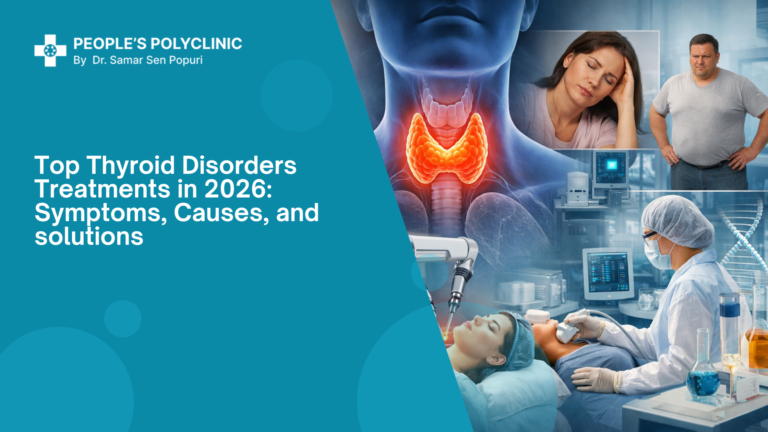
The thyroid gland may be small in size but its influence on human lives is huge. This was made possible because, within the human body, this small gland has control over energy levels, metabolism, moods, and growth; therefore, no matter how small its disorder, one will notice an effect on his or her life. Therefore, there are people within this society who have realized the issues involving the thyroid and have taken care of themselves properly in order to ensure no other complications follow.
As we go forward into 2026, medical science has come further along and will continue to do so, providing better diagnostic means, treatment, and patient-friendly care plans. There has never been a better time to have thyroid issues treated, and while hormone balancing is top priority, so is thyroid health and wellness.
Thus, the goal of this blog provided by People’s Poly Clinic, the best general clinic for healthcare in Hyderabad, is to educate readers about the most common types of thyroid problems and the symptoms, causes, and treatment options for the same.
What are thyroid disorders?
The thyroid gland is located at the front of the neck and resembles the shape of a butterfly. Because it secretes its hormones directly into the bloodstream, it affects how fast or slow a person’s body functions every single day, and almost every function of the human body depends on the thyroid gland.
Additionally, when there is excess or lack of hormones from this gland, that balance is interfered with. Therefore, the body comes up with warning signals that should not be taken lightly, like a variation of energy, sleep, and possibly a variation of mood. These may come on so gradually that they may go unnoticed.
Accordingly, thyroid disorders can be classified as overactive thyroid, underactive thyroid, growth factors, and cancer-related categories. Each type requires a unique approach, and this is exactly where the need for early evaluation comes in. It enables physicians to pick the most appropriate thyroid drugs and advice for individuals.
Common disorders seen in 2026
Hyperthyroidism
This happens when an overactive thyroid gland is present. This happens when too much hormone accelerates body activities and results in an overwhelming symptomatology that appears suddenly. Most people feel uncomfortable within a short period.
Patients may also notice weight loss, sweating, anxiety, rapid heartbeat, and sleep problems. If not treated, these signs and symptoms can lead to bone and heart problems. Hyperthyroidism treatment is essential in order to avoid complications. Such complications can negatively impact the quality of life.
Hypothyroidism
On the other hand, a low-thyroid level causes slower body functions. Hence, fatigue, gaining weight, dry skin, falling of hair, and sad mood are common phenomena due to a low level of thyroid.
Additionally, this condition develops slowly; hence, many people may not even notice the symptoms, and they might think the symptoms have resulted from stress. Thus, screening ensures that the condition is identified before the onset of any problems.
Thyroid Nodules
Sometimes, small nodules may appear inside the gland. For this reason, as long as a person does not have a dangerous type of thyroid cancer, the lumps usually present no symptoms and may not even be noticed.
However, a few will be larger or suspicious; hence, scans and tests are carried out to determine appropriate care and rule out any risk related to thyroid cancer development.
Thyroid Cancer
Although less common, this condition needs immediate attention. Because early stages show minimal symptoms, routine checkups become extremely important for early detection.
Also, modern treatments now offer high recovery rates when detected early. With proper follow-up and medical guidance, most patients return to normal life confidently.
What are the hyperthyroidism causes?
Firstly, immune system disorders remain the leading trigger. Because the body mistakenly attacks the gland, hormone production increases beyond normal levels. This imbalance often affects young and middle-aged adults.
Also, excess iodine intake, certain medications, and inherited traits play a role. Therefore, doctors focus on identifying the root cause before choosing therapy to ensure effective hyperthyroidism treatment.
Because stress also affects hormonal balance, lifestyle factors are carefully evaluated during diagnosis. Managing emotional stress becomes an important part of overall recovery.
Symptoms which should never be ignored
Irregular changes in weight are a strong indication too. Metabolism levels are always changing, and hence, changes in weight are felt quickly, resulting in either gain or loss.
Also, mood swings, irregular heartbeats, thinning hair, as well as swelling on the neck, are of concern as well. This, therefore, implies that taking such conditions lightly would lead to future health concerns because they may affect the person’s comfort and mood.
Therefore, in light of the fact that all people have different symptoms of the disease, it is advisable to have a personalized assessment instead of trying to diagnose it on one’s own
Diagnosis methods used in 2026
Blood tests remain the foundation of diagnosis. Because hormone levels give a clear picture of thyroid hormone imbalance, they help confirm the disorder accurately.
Ultrasound imaging provides detailed views of gland size and structure. Therefore, nodules and swelling are easily detected during early stages.
In some cases, biopsy tests are advised. Because accuracy is critical, these methods ensure safe and correct treatment decisions while ruling out thyroid cancer.
Modern hyperthyroidism treatment options
Treatment varies based on age, severity, and general health. As one particular method may not fit all, care plans are tailored to individual patient needs.
Medications will also be prescribed to help regulate the release of hormones and alleviate symptoms such as palpitations and anxiety. For this reason, monitoring on a regular basis becomes part of long-term care and recovery.
Advanced cases may require radiation therapy or surgery. Since these are permanent treatments, they are an object of careful decision-making regarding evaluation.
Role of thyroid medicine in long-term care
The medication helps in maintaining hormone balance as well as supporting day-to-day functioning. As such, it is recommended that patients ensure they take the medication as indicated on the dosage schedules, which means no gaps in between taking doses.
In addition, modern formulations have fewer side effects, making them safer for long-term use. In this regard, patients feel comfortable with the drug.
Routine testing ensures correct dosages, and if necessary, corrections can be made for the good of overall thyroid well-being.
Diet and lifestyle support
With the below mentioned diet and lifestyle modifications, you can manage your levels of hypothyroidism.
Following a balanced hypothyroidism diet
Nutrients provide a supporting role in recovery. The body needs proper fuel for recovery, hence the importance of foods such as fruits, vegetables, and proteins.
Iodine, selenium, and zinc are naturally supportive of hormone function. Consequently, individual diet plans are designed based on specific requirements and medical advice.
Due to their interference in hormonal endocrinology, they are commonly removed in order to improve energy and digestion.
Importance of overall thyroid health
It is more important to find a balance than to look for a quick fix. Since hormones play an integral role in all bodily functions, such a solution cannot be a short-term fix.
Good quality of sleep, stress level management, and exercise habits favor natural recovery. So, lifestyle changes are always recommended.
As it is apparent that prevention is less complicated than correction, routine screening becomes a pre-requisite.
Advancements in thyroid cancer care
The surgical techniques have improved greatly. Because precision tools reduce risk, recovery time is shorter and outcomes are better.
Also, targeted therapies focus only on affected cells. Therefore, damage to healthy tissue is minimized during treatment.
Because follow-up care ensures remission, patients receive long-term monitoring support and emotional reassurance.
Why does early treatment matter in 2026?
If untreated, the effects of thyroid disorders extend to the heart, bones, fertility, as well as mental health. If not treated, it gets worse.
These decrease medication dependency and increase daily energy levels. Hence, the early diagnosis greatly contributes to the quality of life.
As knowledge has increased, people are asking for help earlier than before, which results in improved life outcomes.
Conclusion: Trusted thyroid care at People’s Poly Clinic
It takes experience and patience to treat thyroid-related disorders correctly and effectively, and it requires a suitable medical guideline for results and comfort at large, given that each patient’s condition is unique.
Under the guidance of Dr. Samarsen Popuri, one of the best general physicians of Hyderabad, People’s Poly Clinic ensures complete general health care with an excellent grasp of thyroid-related issues. Thus, our patients avail of proper diagnosis, care, and treatment facilities all under one roof.
Note that the goal of treatment isn’t merely treatment, but wellness, and with this in mind, we ensure our facility provides lifestyle support, regular check-ups, as well as advanced medical aids. Thus, if you yourself or your loved ones encounter issues with their thyroid, medical aid isn’t really out of reach.
FAQ’S
Can thyroid disorders be cured completely?
Yes, many conditions can be managed effectively with treatment. Regular follow-ups help maintain long-term balance.
How often should thyroid tests be done?
Usually every six to twelve months for stable patients. Frequency depends on individual health needs.
Is medication lifelong for thyroid patients?
Sometimes medication is required for long-term control. However, dosage may change based on test results.
Can stress affect thyroid function?
Yes, stress impacts hormone balance significantly. Therefore, stress management supports better recovery.
When should I consult a doctor?
Immediately after noticing persistent symptoms. Early medical care leads to better outcomes.